Lugged Bike With Modern Components

I've always wonder about this. See I have a '93 Casati and people tell me it's Columbus steel, and to be more specific, it's probably 4130 thin tube chromoly steel. But I notice that the joints are not welded at the bottom bracket area, but it's lugged.And I see that custom bike builders today like to build frames that use lugs, and the bike style they build are similar to those classic Italian 80s & 90s steel frame. Aside, from nostalgia and the desire to ride something classic, is there an advantage or disadvantage of any sort in using lugs over welding? I would imagine quality lugs are more expensive to make than to just weld it?I don't see the big names making lugged frames, only the custom ones. So I can only assume that lugged frames are either expensive to make or not as stiff or both?
Would like to know a little more info. Welding of frames became popular with MTB's in the late 80's. Welding has a lower cost than lugs and brazing and tubesets were made for tig welding. There's nothing wrong with either method, both will produce a strong joint, a welded frame can be lighter, but it all comes down to the tubeset used and the construction. I have three steel frames, a welded Pegoretti, lugged Merckx, and a fillet brazed custom. All three have excellent rides.If you're a steel fan, check out R&A Cycles, they have a large inventory of NOS steel frames. Lugged construction limits the geometries a bit.
You can build a frame with either construction type and still get the same/similar ride qualities. It can be welded, fillet brazed, or brazed with lugs. Most custom builders do lugged or fillet brazed or welded.

I suggest you do a little more looking around, as there is a wealth of information around about the various construction types.All tubing used in the construction of steel bikes (other than stainless) is a type of 4130 chromoly. 4130 is a general class of steels, based on the content of the alloying elements. The different types of alloys allow for higher strengths, allowing for thinner tubing and incrementally lighter frames in the right hands. I've got one of each - an English built Bob Jackson, lugged, full custom geo in Reynolds 853 OS and a welded steel Gunnar - stock geo, tubing unknown.The Gunnar is a softer, easier ride, which is hardly surprising, but it still handles very well. Have never bothered to weigh either, and the Gunnar tends to have 'stuff' hanging off it whereas the BJ is more 'delusionally' rigged.Lugs can be 'fudged' a little - mine had the top tube raised one cm at the front and dropped one cm at its rear end. Which caused no eyebrow raising at BJ's.Ultimately, go with a builder you like, who specialises in whichever technique you fancy.
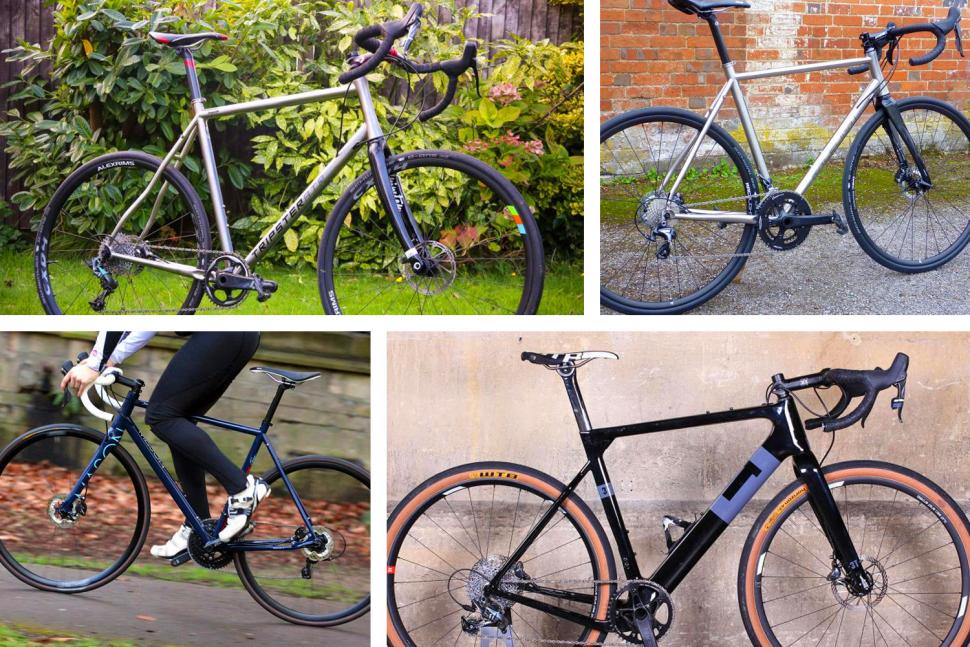
Despite fashion, I still have the odd urge for a Waterford RS33 in their lightest welded steel - painted black with minimal decals, it would look like a plastic frame in the right light;). Getting your geometry right comes first, followed by your aesthetics needs.Good luck with your choicesD. All tubing used in the construction of steel bikes (other than stainless) is a type of 4130 chromoly. 4130 is a general class of steels, based on the content of the alloying elements. The different types of alloys allow for higher strengths, allowing for thinner tubing and incrementally lighter frames in the right hands.This is simply not true.
4130 is a very specific alloy of steel, different from even 4140 and other chrome-moly steels. Reynolds 531 and 753 steels are manga-moly. And none of the air hardening steels (Ox, 853, S3, 631), nor the micro alloyed niobium or Nivachrom is chromoly.Lugs allow generally lighter tubing and lower temperatures to have less impact on heat treated tubing. Generally, a lugged frame of fairly normal gauge tubing will be slightly lighter than the equivalent frame of TIG'd steel. It is a more involved building process than TIG.I think lugs and fillet brazing are more elegant ways to join steel. Bike frames used to be lugged because of the technology of the era.
Tubesets were thin, and difficult to weld without compromising the heat treatment of the tube at the weld zone. It was easier to control the quality of the frame, and the builder made less scrap frames by using lugs and brazing the tubes together. The lug was a neccessity.Modern tubesets, and modern tig welders offer more consistency than before, and frames can be produced more cost effectively by welding them together nowadays. Lock on modern air combat mods. You just put the tubeset in a frame jig, and hit the 'go' button on the robotic welder, and a frame is welded when you come back from your coffee break.
Lugged Bike With Modern Components List
Custom builders can weld with much more reliabiltiy than before, with the improvements in modern tig welders too.Some of the special steel alloys still require low-heat brazing to manufacture them, to insure the strength and quality of the tubeset. So, the lugs still have a legit purpose for some frames. Builders can create some awesome looking lugs these days with the popularity of waterjet cutting, and it creates a very distinctive look on the finished bike that sets it apart from all the clone looking welded frames. Fillet brazing looks sweet, because the frame looks naked, and the joints of the frame look seamless.I still drool over a nice, Columbus SLX tubed frame, with chromed lugs and chainstays.
My 1st couple of bikes were Italian Columbus SL and SLX frames, and I loved them. Bike frames used to be lugged because of the technology of the era.
Tubesets were thin, and difficult to weld without compromising the heat treatment of the tube at the weld zone. It was easier to control the quality of the frame, and the builder made less scrap frames by using lugs and brazing the tubes together. The lug was a neccessity.Modern tubesets, and modern tig welders offer more consistency than before, and frames can be produced more cost effectively by welding them together nowadays. You just put the tubeset in a frame jig, and hit the 'go' button on the robotic welder, and a frame is welded when you come back from your coffee break. Custom builders can weld with much more reliabiltiy than before, with the improvements in modern tig welders too.Some of the special steel alloys still require low-heat brazing to manufacture them, to insure the strength and quality of the tubeset. So, the lugs still have a legit purpose for some frames. Builders can create some awesome looking lugs these days with the popularity of waterjet cutting, and it creates a very distinctive look on the finished bike that sets it apart from all the clone looking welded frames.
Fillet brazing looks sweet, because the frame looks naked, and the joints of the frame look seamless.I still drool over a nice, Columbus SLX tubed frame, with chromed lugs and chainstays. My 1st couple of bikes were Italian Columbus SL and SLX frames, and I loved them.+1. I still drool over old steel De Rosas, Olmos, Benottos and of course, Nagos (to name a few) with their well-crafted lug work and superb tubing. Even the Japanese bike companies and many American companies (Paramount, Medici and Specialized come to mind) had some bikes with well-designed, sculpted lugwork.
All were absolutely gorgeous no matter how you define beauty. The attention to detail that was given to those old steeds was second to none. While I love my modern carbon and aluminum bikes, they don't evoke the same feelings as those vintage steel racers from decades ago. This is simply not true. 4130 is a very specific alloy of steel, different from even 4140 and other chrome-moly steels. Reynolds 531 and 753 steels are manga-moly.
And none of the air hardening steels (Ox, 853, S3, 631), nor the micro alloyed niobium or Nivachrom is chromoly.Lugs allow generally lighter tubing and lower temperatures to have less impact on heat treated tubing. Generally, a lugged frame of fairly normal gauge tubing will be slightly lighter than the equivalent frame of TIG'd steel. It is a more involved building process than TIG.I think lugs and fillet brazing are more elegant ways to join steel.Ox platinum and 853 is 4340 (or very close to it its). 631 is unhardened 853. This is a form of chromoly.Carbon, C - 0.370 - 0.430%Chromium, Cr - 0.700 - 0.900%Iron, Fe - 95.195 - 96.33% As remainderManganese, Mn - 0.600 - 0.800%Molybdenum, Mo - 0.200 - 0.300%Nickel, Ni - 1.65 - 2.00%Phosphorous, P. Ox platinum and 853 is 4340 (or very close to it its).
631 is unhardened 853. This is a form of chromoly.Carbon, C - 0.370 - 0.430%Chromium, Cr - 0.700 - 0.900%Iron, Fe - 95.195 - 96.33% As remainderManganese, Mn - 0.600 - 0.800%Molybdenum, Mo - 0.200 - 0.300%Nickel, Ni - 1.65 - 2.00%Phosphorous, P. If 4340 was 'pretty much the same' as 853, it would be an air hardening steel, not an oil quenching steel. Many steels contain chrome and molybdenum, but that doesn't mean they get referred to as 'chromoly'. 4340 contains manganese, but that doens't make it manga-moly, either.853 is more like A2 in the way the alloy dictates properties and hardening.Is it?FYI air hardening means air quenching, oil quenching means oil hardening.You don't really know what air hardening means.Just for the record a real air hardening steel would get brittle as glass after welding.A typical air hardening steel is HSS types of steel and stainless tool steels. Air hardening steels are not weldable at room temperature at all and they need tempering after welding.I suggest you pick up some books.These are good.
Is it?FYI air hardening means air quenching, oil quenching means oil hardening.You don't really know what air hardening means.Just for the record a real air hardening steel would get brittle as glass after welding.A typical air hardening steel is HSS types of steel and stainless tool steels. Air hardening steels are not weldable at room temperature at all and they need tempering after welding.I suggest you pick up some books.These are good.Quenching and hardening are synonyms, and I used them interchangeably. As did you.Air hardening steels are not the same as any of the steels in the 4130 series, which you should know from those books. 853 heat treats like A2 (hardens in an air quenchant) but is an extrudable steel, like 4130. It is not either one, but has properties similar to both - which is the point I was making.I don't have all those books - the ones I use for my heat treating are more specific to black smithing. But it doesn't appear that your exposure to them is helping you. All of these steels are 'tool steels', a label we use because it implies a range of hardenable structural steels without needing to confuse things by referring to the chemistry.
Chromoly is short for a narrow range of tool steels, and it just confuses matters when someone tries to make that term inclusive to more steels, since so many of them have those alloying elements in them.